
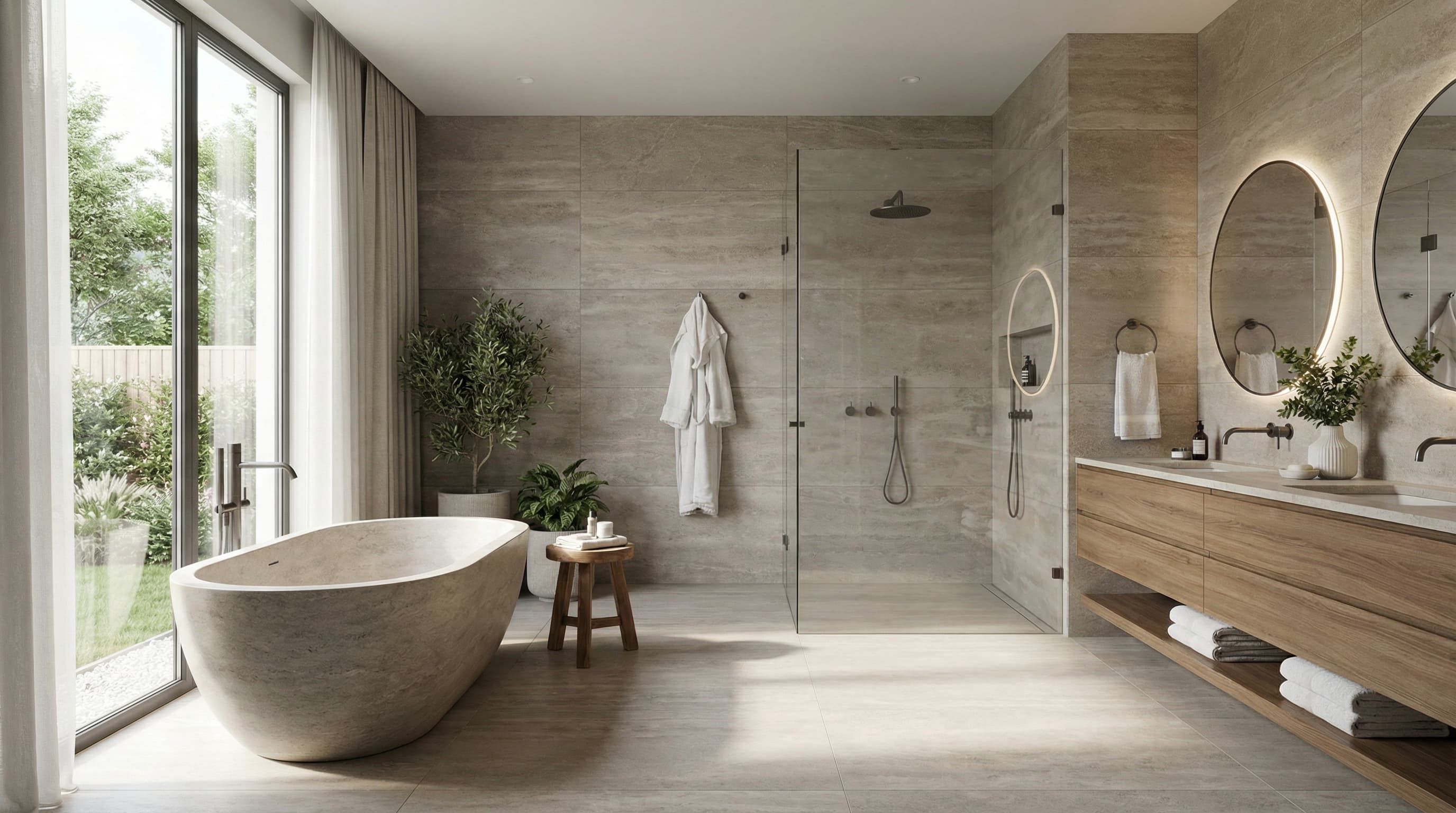
Bathroom remodel prices vary more than almost any other home project, because two bathrooms that look similar from the doorway can carry completely different price tags once you account for plumbing, tile, and what's hiding behind the walls. Below are the real ranges we see on the Eastside, broken down by tier, by line item, and by bathroom type, so you can plan your budget before you call anyone.
How much does a bathroom remodel cost in Washington?
Most bathroom remodels on the Eastside run $15,000 to $30,000 for a full mid-range job, with cosmetic refreshes starting around $8,000 and high-end or layout-changing remodels reaching $50,000 or more. Where your project lands inside that spread depends mainly on what you're keeping versus replacing, and whether any plumbing has to move.
These numbers reflect Puget Sound labor and material costs in 2026, not national averages — online cost calculators built on national data tend to run low for Washington, and King and Snohomish county jobs specifically. Every figure in this guide is a typical range for planning purposes, not a quote. The only way to get a firm number for your bathroom is a free on-site estimate. For city-specific pricing and what's included, see bathroom remodel in Bellevue & the Eastside.
What are the three bathroom remodel cost tiers?
Washington bathroom remodels generally fall into three tiers, and knowing which one describes your project is the fastest way to set a realistic budget.
| Tier | What's typically included | Typical cost range |
|---|---|---|
| Cosmetic refresh | New vanity, fixtures, paint, like-for-like layout | $8,000 – $15,000 |
| Full mid-range remodel | New tile, shower, vanity, flooring | $15,000 – $30,000 |
| High-end or layout change | Moved plumbing, primary bath, premium finishes | $30,000 – $50,000+ |
A cosmetic refresh swaps out what's failing or dated without touching the layout or the plumbing lines — think new vanity, toilet, faucets, paint, and maybe flooring. A full mid-range remodel goes further: new tile, a new shower or tub, new vanity, and new flooring, still inside the existing footprint. High-end and layout-change projects move plumbing, expand the footprint, or bring in premium materials like natural stone or custom cabinetry, and that's where primary bathrooms usually land.
What drives the cost of a bathroom remodel up or down?
Three things move a bathroom remodel budget more than anything else: your tile and fixture selections, whether the plumbing has to move, and what turns up once the walls are open.
Tile and fixture selections. Porcelain tile versus natural stone, a stock vanity versus a custom build, a standard tub-shower versus a curbless shower with frameless glass — these choices alone can swing a mid-range job by five figures. Selections are the part of the budget you control most directly.
Whether plumbing moves. Relocating a toilet, sink, or shower drain means cutting into the slab or subfloor, rerouting supply and drain lines, and often triggers a permit. Keeping every fixture in its current location is the single biggest lever a homeowner has over the final price — see do you need a permit to remodel a bathroom in Washington for when that permit requirement kicks in.
What's behind the walls. A lot of Eastside homes were built in the 1960s through 1980s, and once the drywall or tile comes down around an old tub or shower, it's common to find rot, an old slow leak, galvanized supply lines, or wiring that no longer meets code. We can't price damage we can't see, so a contingency line belongs in any mid-range or larger bathroom budget.
Where does the money actually go? A line-item breakdown
On a typical mid-range Washington bathroom remodel, roughly 40–50% of the budget goes to labor, and the rest splits across tile, fixtures, plumbing, electrical, and permits.
| Line item | Typical share of budget | Notes |
|---|---|---|
| Labor (demo, framing, tile-setting, install) | 40% – 50% | Rises with layout complexity |
| Tile & flooring | 15% – 20% | The biggest material swing — porcelain vs. natural stone |
| Fixtures (vanity, toilet, tub/shower, faucets) | 15% – 20% | Stock vs. custom changes this fast |
| Plumbing (rough-in, fixtures, waterproofing) | 8% – 12% | Higher if a fixture relocates |
| Electrical (lighting, fan, GFCI, heated floor) | 5% – 8% | Higher with layout changes |
| Permits & inspections | 1% – 3% | Set by your city, not by us |
These are typical planning bands for a mid-range remodel, not a quote — your actual mix shifts depending on your selections and your bathroom's condition. A written estimate breaks out the real dollar amount for each line before any work starts.
Planning a bathroom remodel on the Eastside? Seven is a licensed WA contractor (L&I SEVENGC808NG), rated 4.9★ on Thumbtack across 93 jobs and A+ with the BBB. Free on-site estimate → call or text (877) 738-3642, or request a quote.
How much does a half bath, full bath, or primary bathroom cost?
A powder room usually lands at the low end of the cosmetic-refresh tier, a standard full or hallway bath typically falls in the mid-range tier, and a primary or en-suite bathroom is the most common candidate for the high-end tier.
Powder or half bath (no tub or shower). With no tub or shower to waterproof and a small footprint — often under 20 square feet — a half-bath refresh is usually one of the least expensive updates in the house, unless you're adding plumbing where none currently exists, which pushes it toward the mid-range tier.
Standard full or hallway bath (tub-shower combo, single vanity). These sit squarely in the full mid-range tier most of the time. New tile, a new tub or shower, a new vanity, and new flooring add up quickly, but staying inside the existing footprint keeps the job out of high-end territory.
Primary or en-suite bath. Primary bathrooms are where the high-end tier shows up most often, because these projects tend to add square footage of tile, a separate shower and freestanding tub, double vanities, and premium finishes — and they're also where plumbing relocations happen most.
Why does bathroom remodel labor cost more on the Eastside than the national average?
Skilled trade labor and the cost of running a licensed contracting business both run higher in King and Snohomish counties than the national average, and that shows up directly in your remodel's labor line.
Puget Sound wages for tile-setters, plumbers, and electricians run above the national average, and a licensed, bonded, and insured contractor carries overhead — workers' comp, L&I premiums, liability coverage — that unlicensed or out-of-area labor doesn't. Demand for skilled trade crews on the Eastside is also high relative to supply, especially in the spring and summer remodel season, and permit and disposal fees in King and Snohomish counties add to the total. None of that is unique to Seven — it's the honest cost of doing licensed work in this market, and it's a big part of why a WA estimate will usually run above a generic national number.
How do you control the cost without cutting corners?
The biggest lever is keeping your existing layout — every dollar you don't spend moving plumbing is a dollar you can put into finishes.
- Keep fixtures where they are. A remodel that reuses the existing toilet, sink, and shower locations avoids the slab-cutting and re-routing that drives up both labor and permit scope.
- Choose mid-grade materials over premium or custom. A well-chosen porcelain tile can look nearly as clean as natural stone at a fraction of the cost, with less long-term maintenance.
- Finalize selections before demo starts. Changing your mind about tile or a fixture mid-project almost always costs more than making the same choice up front.
- Phase the project if the budget is tight. Get the wet work — waterproofing, plumbing, tile — done right the first time, and treat swappable items like a mirror or light fixture as a later phase.
- Get one real on-site estimate. A written scope from an actual walkthrough is the only way to know your real number; stacking online calculators just adds noise.
Does a bathroom remodel pay for itself at resale?
A well-done bathroom remodel typically recovers a solid share of its cost at resale, and it tends to hold up better than most other rooms in the house, but the exact payback depends on your tier, your neighborhood, and market conditions when you sell.
Cosmetic refreshes and mid-range remodels with neutral, broadly appealing finishes tend to hold value best, because they appeal to the widest pool of buyers. Highly personalized or ultra-premium finishes narrow that pool and don't always return their extra cost. A dated or non-functional bathroom is also a common item on a buyer's inspection punch list, so even a modest refresh can help a home show and sell faster — separate from whatever percentage of the remodel cost it recovers on paper.
Frequently asked questions
Is a $10,000 bathroom remodel realistic in Washington?
Yes, for a cosmetic refresh — $10,000 sits inside the $8,000–$15,000 cosmetic-refresh range and typically covers a new vanity, toilet, fixtures, paint, and flooring without moving plumbing or changing the layout. If you want new tile in the shower or a layout change, $10,000 gets tight fast. A free on-site estimate will tell you exactly what fits your specific bathroom at that budget.
How much does a bathroom remodel cost per square foot on the Eastside?
Most Eastside bathroom remodels fall somewhere between roughly $200 and $700 per square foot, and smaller bathrooms usually land toward the top of that range because costs like plumbing rough-in, waterproofing, and permits don't shrink with the room. Per-square-foot pricing is a rough planning number, not a quote — the line-item breakdown above is a more accurate way to estimate your total.
Do I need a permit for a bathroom remodel in Washington?
Usually yes if you're moving plumbing, changing electrical, or altering walls — a like-for-like cosmetic swap often doesn't require one, but your city makes the final call. Permit and inspection fees are one of the smaller line items in the budget, but skipping a required permit can cost far more at resale. For the full rundown of when Washington requires a permit and how the process works, see do you need a permit to remodel a bathroom in Washington.
Is a tub-to-shower conversion cheaper than a full remodel?
Usually yes — a tub-to-shower conversion is a smaller scope than a full remodel and typically costs less than the full mid-range tier, since it's mainly plumbing, waterproofing, tile, and glass rather than a full gut of the room. It's still real construction work, so it costs more than a cosmetic refresh too. See the full breakdown at tub-to-shower conversion cost & options.
How do I get an exact price instead of a range?
The only way to get an exact number is a free on-site estimate, where we measure your bathroom, walk through your material selections, and hand you a fixed written scope and price before any work starts. Every dollar figure in this guide is a planning range — call or text (877) 738-3642 to get yours.