
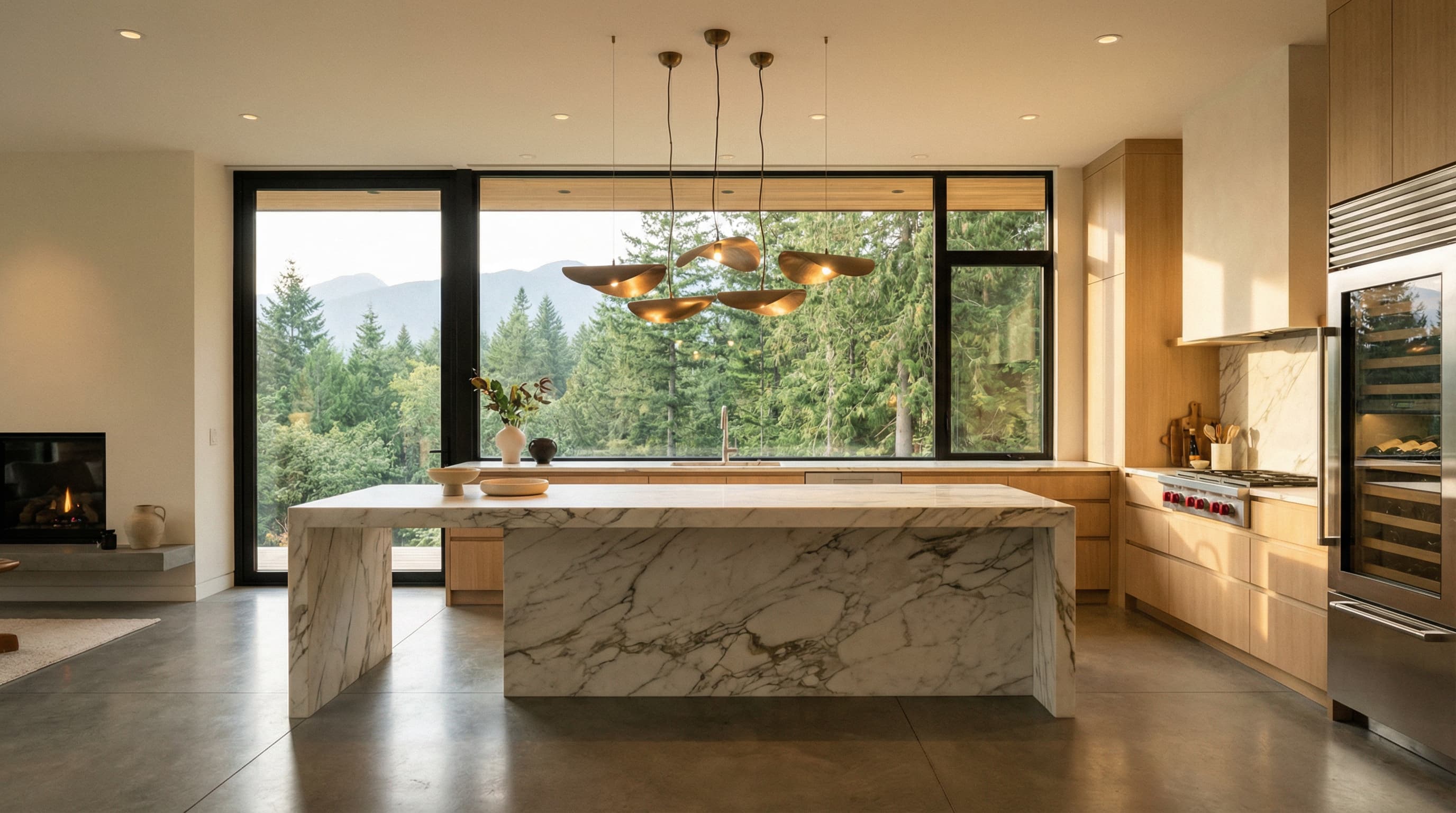
A kitchen is the most expensive room most homeowners will ever remodel, and the reason is simple: it's the one room that combines cabinetry, countertops, appliances, plumbing, and electrical all in the same footprint. Two kitchens the same size can differ by $40,000 once you account for cabinet grade, whether the layout moves, and what the last remodel left behind the walls. Below are the real ranges we see on the Eastside, broken down by tier, by line item, and by kitchen type, so you can set a budget before you call anyone.
How much does a kitchen remodel cost in Washington?
Most kitchen remodels on the Eastside run $30,000 to $70,000 for a full mid-range job, with cosmetic refreshes starting around $15,000 and high-end or layout-changing kitchens reaching $150,000 or more. Where your project lands inside that spread comes down to your cabinets, whether you keep the existing layout, and the grade of appliances and countertops you choose.
These figures reflect Puget Sound labor and material costs in 2026, not national averages — online cost calculators built on national data tend to run low for King and Snohomish county work. Every number in this guide is a typical range for planning, not a quote. The only way to get a firm price for your kitchen is a free on-site estimate. For city-specific pricing and what's included, see kitchen remodel in Bellevue & the Eastside.
What are the three kitchen remodel cost tiers?
Washington kitchen remodels generally fall into three tiers, and knowing which one describes your project is the fastest way to set a realistic budget.
| Tier | What's typically included | Typical cost range |
|---|---|---|
| Cosmetic refresh | Cabinet refacing or paint, new counters, appliances, hardware, like-for-like layout | $15,000 – $30,000 |
| Full mid-range remodel | New semi-custom cabinets, quartz counters, flooring, most appliances | $30,000 – $70,000 |
| High-end or layout change | New custom cabinets, moved walls or plumbing, pro-grade appliances, stone | $70,000 – $150,000+ |
A cosmetic refresh updates what looks dated without touching the layout — reface or repaint the existing cabinet boxes, swap countertops and hardware, and drop in new appliances where the old ones stood. A full mid-range remodel replaces the cabinets outright with semi-custom units, adds new quartz or stone counters, new flooring, and new appliances, all inside the current footprint. High-end and layout-change projects are where the number climbs fast: custom cabinetry, a removed wall to open the kitchen to the living space, a relocated sink or range, and pro-grade appliances that can cost as much as an entire cosmetic refresh on their own.
What drives the cost of a kitchen remodel up or down?
Four things move a kitchen budget more than anything else: the cabinets, whether the layout changes, the appliance and countertop grade you pick, and what turns up once the walls and floor are open.
Cabinets. Cabinetry is almost always the single largest line in a kitchen remodel, and the jump from stock to semi-custom to fully custom is the biggest lever on the whole budget. Stock cabinets come in fixed sizes off a shelf; semi-custom lets you adjust dimensions and finishes; custom is built to your exact kitchen with no filler panels. If your existing cabinet boxes are solid, refacing or repainting them instead of replacing can move a full remodel back toward the cosmetic tier.
Whether the layout changes. Keeping the sink, range, and refrigerator in their current spots avoids rerouting plumbing, gas, and electrical, and it's the single biggest thing a homeowner controls. Moving the sink means new supply and drain lines; adding an island with a sink or cooktop means running services under the slab or floor; and removing a wall to open the kitchen can mean a structural beam and an engineer's sign-off if that wall is load-bearing.
Appliance and countertop grade. A standard appliance package versus a pro-grade suite is easily a five-figure swing on its own, and countertops range from laminate at the low end through quartz in the middle to natural stone and specialty surfaces at the top. These are the selections you control most directly, and they're where a mid-range budget most often creeps upward.
What's behind the walls and under the floor. Many Eastside homes were built between the 1960s and 1980s, and once the old kitchen comes out it's common to find an undersized electrical panel, aluminum or knob-and-tube wiring, plumbing that's due for replacement, or a subfloor that has to be repaired before new flooring goes down. Bringing a kitchen's electrical up to current code — dedicated circuits, GFCI protection, proper lighting — is frequently part of the job whether or not you planned for it, so a contingency line belongs in any mid-range or larger kitchen budget.
Where does the money actually go? A line-item breakdown
On a typical mid-range Washington kitchen remodel, cabinetry and labor together usually account for more than half the budget, and the rest splits across appliances, countertops, flooring, plumbing, electrical, and permits.
| Line item | Typical share of budget | Notes |
|---|---|---|
| Cabinetry | 25% – 35% | The biggest single line — stock vs. semi-custom vs. custom |
| Labor (demo, install, tile, finish) | 20% – 30% | Rises with layout changes and wall removal |
| Appliances | 12% – 18% | Standard package vs. pro-grade swings this fast |
| Countertops | 8% – 12% | Laminate vs. quartz vs. natural stone |
| Flooring | 5% – 8% | Higher with larger or open-concept kitchens |
| Plumbing & electrical | 8% – 12% | Higher if the sink or appliances move, or the panel needs work |
| Permits & inspections | 1% – 3% | Set by your city, not by us |
These are typical planning bands for a mid-range remodel, not a quote — your real mix shifts with your cabinet choice, your appliances, and your kitchen's existing condition. A written estimate breaks out the actual dollar amount for each line before any work starts.
Planning a kitchen remodel on the Eastside? Seven is a licensed WA contractor (L&I SEVENGC808NG), rated 4.9★ on Thumbtack across 93 jobs and A+ with the BBB. Free on-site estimate → call or text (877) 738-3642, or request a quote.
How much does a small, standard, or open-concept kitchen cost?
A small galley kitchen usually lands at the low end of its tier, a standard L- or U-shaped kitchen falls squarely in the mid-range, and an open-concept kitchen with an island is the most common candidate for the high-end tier.
Small or galley kitchen. With less cabinet run and less countertop to buy, a compact kitchen costs less in materials, but the per-square-foot figure often looks high because the expensive parts — appliances, plumbing, a code-compliant electrical panel — don't shrink just because the room is small.
Standard L- or U-shaped kitchen. These sit in the middle of the range most of the time. New semi-custom cabinets, quartz counters, a full appliance package, and new flooring add up quickly, but keeping the existing walls and plumbing locations holds the job inside the mid-range tier.
Open-concept kitchen with an island. Open kitchens are where the high-end tier shows up most, because they usually involve removing a wall, adding an island that may carry its own sink or cooktop, more linear feet of cabinetry and stone, and the upgraded lighting and electrical that a larger open space needs.
Why does kitchen remodel labor cost more on the Eastside than the national average?
Skilled trade labor and the cost of running a licensed contracting business both run higher in King and Snohomish counties than the national average, and that shows up directly in your kitchen's labor line.
Puget Sound wages for cabinet installers, plumbers, and electricians run above the national average, and a licensed, bonded, and insured contractor carries overhead — workers' comp, L&I premiums, liability coverage — that unlicensed or out-of-area labor doesn't. Demand for skilled crews on the Eastside stays high relative to supply, especially through the spring and summer remodel season, and permit and disposal fees in King and Snohomish counties add to the total. None of that is unique to Seven; it's the honest cost of licensed work in this market, and it's a big part of why a real Washington estimate usually runs above a generic national number.
How do you control the cost without cutting corners?
The biggest lever is keeping your existing layout — every dollar you don't spend moving cabinets, plumbing, or walls is a dollar you can put into finishes you'll actually see and use.
- Keep the sink, range, and fridge where they are. Reusing the existing plumbing and appliance locations avoids the rerouting that drives up both labor and permit scope.
- Reface or repaint solid cabinet boxes. If the existing boxes are structurally sound, refacing or a quality repaint delivers most of the visual change for a fraction of the cost of full replacement.
- Choose semi-custom over custom, and quartz over natural stone. Semi-custom cabinets and quartz counters cover the vast majority of kitchens beautifully, with less cost and less long-term maintenance than fully custom cabinetry and natural stone.
- Finalize selections before demo starts. Changing your mind about cabinets, counters, or an appliance mid-project almost always costs more than making the same choice up front.
- Get one real on-site estimate. A written scope from an actual walkthrough is the only way to know your real number; stacking online calculators just adds noise. It's also your chance to vet the contractor — see how to choose a general contractor in Bellevue.
Does a kitchen remodel pay for itself at resale?
A well-done kitchen remodel typically recovers a meaningful share of its cost at resale, and it's one of the first things buyers judge a home on, but the exact payback depends on your tier, your neighborhood, and the market when you sell.
Industry cost-versus-value studies consistently find that minor and mid-range kitchen remodels with neutral, broadly appealing finishes tend to return a larger share of their cost than ultra-premium or highly personalized ones, because they appeal to the widest pool of buyers. A dated or non-functional kitchen is also one of the most common reasons a home lingers on the market, so even a cosmetic refresh can help a house show and sell faster — separate from whatever percentage of the remodel it recovers on paper. If you're weighing more than one project, our bathroom remodel cost guide walks through the same tiers for the other room buyers scrutinize most.
Frequently asked questions
Is a $30,000 kitchen remodel realistic in Washington?
Yes, for a cosmetic refresh or the low end of a mid-range job — $30,000 sits at the top of the $15,000–$30,000 refresh range and typically covers cabinet refacing or paint, new countertops, new appliances, hardware, and flooring without moving the layout. If you want all-new semi-custom cabinets or to open the kitchen up, $30,000 gets tight quickly. A free on-site estimate will tell you exactly what fits your specific kitchen at that budget.
How much does a kitchen remodel cost per square foot on the Eastside?
Most Eastside kitchen remodels fall somewhere between roughly $150 and $500 per square foot, but per-square-foot pricing is a weaker guide for kitchens than for most rooms, because cabinets and appliances — not floor area — drive the bulk of the cost. A small kitchen can cost as much per square foot as a large one, so the line-item breakdown above is a more accurate way to estimate your total than any per-foot figure.
What is the most expensive part of a kitchen remodel?
Cabinetry is almost always the single most expensive line item, typically running a quarter to a third of the total budget, followed by labor and then appliances. Because cabinets carry so much of the cost, the choice between stock, semi-custom, and custom — or refacing what you already have — is the biggest single decision you'll make about your budget.
Do I need a permit for a kitchen remodel in Washington?
Usually yes if you're moving plumbing, changing electrical, or altering walls — a like-for-like cosmetic swap sometimes doesn't require one, but your city makes the final call. Kitchen remodels trigger permits more often than people expect, because bringing older wiring up to current electrical code is frequently part of the work. Permit and inspection fees are a small line in the budget, and skipping a required permit can cost far more at resale.
Is refacing cabinets cheaper than replacing them?
Usually yes — refacing keeps your existing cabinet boxes and replaces only the doors, drawer fronts, and visible surfaces, so it typically costs a fraction of full replacement and keeps a kitchen in the cosmetic-refresh tier. It only works if the existing boxes are structurally sound and the layout is staying put; if the boxes are failing or you're changing the footprint, new cabinets are the better spend.
How do I get an exact price instead of a range?
The only way to get an exact number is a free on-site estimate, where we measure your kitchen, walk through your cabinet and material selections, and hand you a fixed written scope and price before any work starts. Every dollar figure in this guide is a planning range — call or text (877) 738-3642 to get yours.